Few scientists in history have had to fight as hard simply to be allowed to work. Born in Warsaw in 1867, at a time when Poland was under Russian occupation and women were (1) from university, they made a deal with their sister. They would work as a private tutor to fund her medical studies in Paris, and she would return the favour once qualified. It took years, but eventually they made it to France, (2) at the Sorbonne and threw themselves into physics and mathematics with remarkable dedication, graduating (3) of their class.
They met and married a fellow scientist, and together they began investigating a curious phenomenon. Certain (4) seemed to emit energy spontaneously, with no external (5). The word they coined for this was radioactivity. In 1898 they announced the discovery of two new elements, polonium, named after their (6) homeland, and radium.
In 1903 they became the first (7) to win a Nobel Prize. Eight years later they won a second, in a different scientific field, a feat nobody has (8) before or since. The French scientific establishment, which had repeatedly refused to (9) them as a member on the grounds of gender, must have found that difficult to explain.
They died in 1934 from a blood disease almost certainly caused by decades of working with radioactive materials, often carrying test tubes of isotopes in their coat (10) with no idea of the danger. The notebooks they kept are still so radioactive they are stored in lead-lined boxes.
Now check your answers:
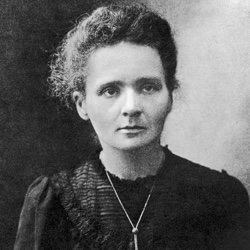
Who is this baiography about?
If you don't know their identity, click:
▶ Click to show the transcript and the correct answers.
Few scientists in history have had to fight as hard simply to be allowed to work. Born in Warsaw in 1867, at a time when Poland was under Russian occupation and women were (1) banned from university, they made a deal with their sister. They would work as a private tutor to fund her medical studies in Paris, and she would return the favour once qualified. It took years, but eventually they made it to France, (2) enrolled at the Sorbonne and threw themselves into physics and mathematics with remarkable dedication, graduating (3) top of their class.
They met and married a fellow scientist, and together they began investigating a curious phenomenon. Certain (4) elements seemed to emit energy spontaneously, with no external (5) trigger. The word they coined for this was radioactivity. In 1898 they announced the discovery of two new elements, polonium, named after their (6) occupied homeland, and radium.
In 1903 they became the first (7) woman to win a Nobel Prize. Eight years later they won a second, in a different scientific field, a feat nobody has (8) matched before or since. The French scientific establishment, which had repeatedly refused to (9) admit them as a member on the grounds of gender, must have found that difficult to explain.
They died in 1934 from a blood disease almost certainly caused by decades of working with radioactive materials, often carrying test tubes of isotopes in their coat (10) pockets with no idea of the danger. The notebooks they kept are still so radioactive they are stored in lead-lined boxes.
▶ Click to show questions for discussion.
This individual was banned from university in their home country because of their gender. Do you think women still face barriers in science and education today?
They made a deal with their sister to support each other's education. Do you think family support is important in achieving your goals?
They won Nobel Prizes in two different scientific fields, a feat nobody has matched. Do you think it is possible to be truly exceptional in more than one field?
The French scientific establishment refused to admit them as a member on the grounds of gender. How do you think institutions should handle past discrimination?
They died from a disease caused by their own research, without knowing the danger. Do you think scientists have a responsibility to fully understand the risks of their work before pursuing it?